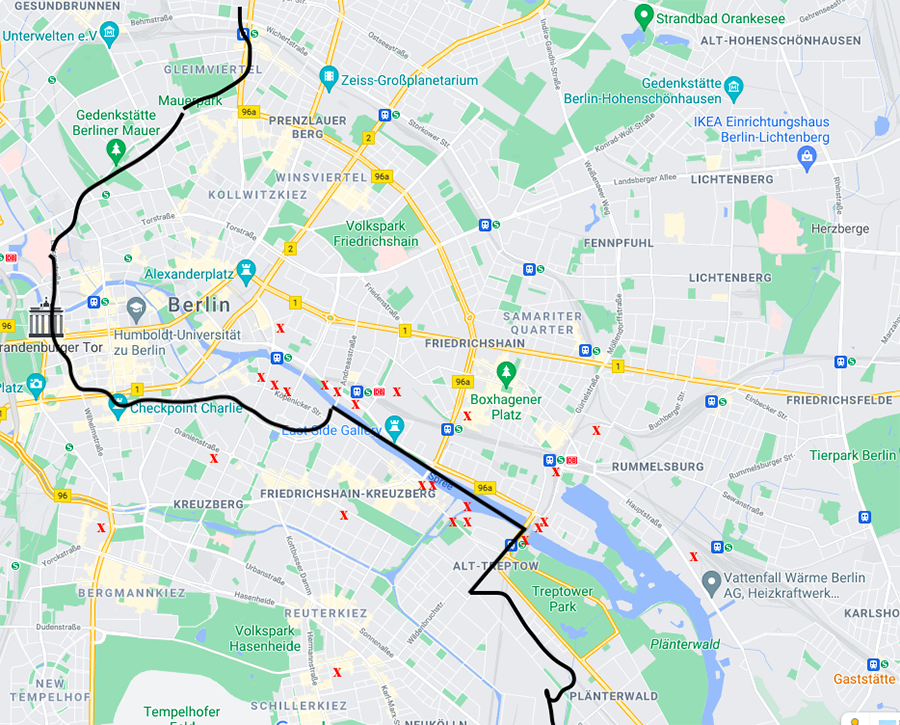
Figure 1: Clubs in East and West Berlin
Foraging Places and Spaces through Dance: The Mycelium-like Spaces of Post-1989 Berlin Affording its Ongoing Club Culture
University of Amsterdam (Netherlands)
<http://dx.doi.org/10.12801/1947-5403.2024.16.01.10>
Sheltered from direct light, mycelium waits for its time and much like a dancer it flourishes in the hidden and humid spaces, far from sterile and bright environments. What seems like a dystopian habitat at first can become a source of life for those seeking collaborative approaches to restructuring and resilience in times of drastic change and deterioration.
The year 1989 saw the introduction of a new sense of precariousness due to the imminent collapse of the known polarised world order. If a century of exhilarating globalised warfare had not already been enough destabilisation for the world, then the last decade of the 20th century manifested the instability in a grand manner. Despite all this, the 90s are a pinnacle of hope in popular cultural memory. They offered a glimpse of the promised progress settling in, a glimpse of resurgence from the ruins of the recent active and passive wars.
The sensation of resurgence always strikes me in autumn. With every end of summer, I dread colder days. That is, until the first mushrooms fruit. They act as a reminder of all the possibilities outside of summery bliss. Whenever I read about mushrooms and mycelium, I am in awe of their resilience, their determination to endure and keep popping up in seemingly hostile spaces. In her 2015 book, The Mushroom At The End of The World, Anna Lowenhaupt Tsing gracefully describes the life of the matsutake mushroom which thrives in places ridden by human intervention or even destruction. She stresses the collaborative survival and entanglement of all—but especially this—species of mushroom. The place I grew up in, and its cultural rebirth after a trouble-ridden 20th century parallels the growing cycles of mycelia and its spores and mushrooms. This place is Berlin, Germany.
Like many other capitals, Berlin has a rich history in cultural and architectural expressions. It is uniquely characterised by its drastic changes due to the bombings of World War II, the following divide of the city and its delayed reconstruction. A chance to return to the status of the metropolis it used to be seemed to have been missed, but Berlin nonetheless reinvented itself in the past three decades. It was one of the first places to become a hub of electronic dance music outside of the English-speaking world, and it would only be fair to assume that in a reunited city these idiomatic clubs would also be spread across its entirety. When you search for clubs in Germany’s capital, however, most points on the map will be located to the East and around the river Spree, dividing the city diagonally.
After the fall of the wall, Berlin functioned as a new, fertile breeding ground for dreams of the people of the East and West, as well as aficionados of new electronic sounds. The 1990s were overwhelming for the city. The fluctuating composition of people, cultural events, locations and perceptions thereof, alongside the many buildings and areas waiting (if not begging) for resignification, offered a previously unseen multitude of potential for abandoned, previously state-owned buildings and newly accessible land that had been locked away in the border zones. Initially, the local history was renegotiated by leaving some state-owned buildings from the German Democratic Republic (GDR) untouched, while others were replaced with Prussian-style buildings they had once replaced themselves, or with entirely new spaces. The unified Berlin constructed its mycelium in the spaces of contemporary Europe as a descendant of the Prussian Empire and as a post-soviet space, but most notably as a city of possibilities. Entangled through their shared precarious survival, these different social subsets collaboratively explored avenues and venues others might have shied away from. The city still has a lot of so-called wastelands that the government and private investors have yet to touch. This large amount of potential grew into a bubble, only to burst mid-decade. Nonetheless, the underlying network of dancers and party organisers remained intact below the surface, simply waiting for their time to fruit again.
Reminiscent of this burst, Berlin’s perceived, imagined and lived identity as a capital, as a cultural metropolis and as a European city still invites new spaces to pop up amongst the mélange of architecture. Creatives and their communities have been and still are using this intertwined and seemingly everlasting potential to let their ideas fruit like mushrooms across the old border zone and in previously state-owned territories. The ongoing reconstruction and resignification continue to underline the symbolic reproduction of culture in the urban landscape. Whilst there are many interpretations and uses of space across Berlin, the ones that keep fruiting are clubs. The temporary escape, the exuberant self, collective expression and the inorganic sounds continue to echo amongst the concrete and bricks alike. Key to this process is what Tsing calls “contamination”. New collaborations amongst mycelia or humans can only fruit when they are contaminated with something or someone new. Contamination introduces the new and, in consequence, diversifies the space which unfortunately does not always make it more resilient for the future (Tsing 2015: 29, 43). It is a collaborative effort to (de)stabilise spaces that are characterised by the seasonality with which people come and go; places are available and evaporate. Collectively they aim, intentionally and unintentionally, to strengthen the clubbing mycelium and cross-contaminate spaces and people to ensure there will be dancing, sporing, growing, fruiting.
Under the deliberately vague waiver of “temporary use”, the city’s senate granted permission to almost anything in the mid-90s. The sheer amount of places that were ready to germinate and transform into something new is still unique in comparison to other European cities. The city’s policymakers have turned to capitalise on this. As a result, the wastelands and their temporary uses take on a central role in the marketing of the city as a free and creative hub nowadays. Berlin certainly experienced physical gentrification, but the symbolism is of high relevance there too. The symbolic rebirth as a creative city established Berlin as a returning player amongst the big cities of Europe more than the physical reconstruction of the cityscape could have. This type of appropriation logically leads to frustrations and conflicts in the various scenes making use of voided spaces. Creators and users of temporary spaces, landowners, policymakers and potential investors are in a continuous interplay and negotiation about the spaces in Berlin causing old ones to be scrapped or redesigned while new ones pop up regularly. In contrast to other economically devastated cities across the globe, in Berlin the empowerment of the users and creators of these spaces is much greater. It results in a preserved instability, akin to seasons of rain and draught, that enables the constant production of new cultural capital relying on Berlin's wastelands. If all physical space was to be exhausted, the social self-perception of Berlin would crumble too. If all clubs and other creative spaces were to be permanent, one could argue that their innovative feel might get lost. It seems to be that club culture has to fruit like mushrooms in autumn before decomposing and leaving nothing but inspiration and the invisible mycelium of dancers behind, waiting keenly for a new season and new scenery of sporulation.
But if the club is gone and the new one is not yet extant, then where do the dancers go? They create a new space themselves. The first techno party in East Berlin was Tekknozid. It was organised in an old SED (political party ruling the GDR) sponsored youth centre before it moved to the Haus Junger Talente in the Klosterstraße, which is located in the historic centre of the city (Denk and von Thülen 2012: 98). The connotations of these types of spaces and the euphoria attached to the socio-political momentum of 1989 equally contributed to the establishment of the new music’s spaces. By reclaiming these politically charged locations, clubbers collectively not only resignified the physical space but also acknowledged its affordances and potential future. The newly created dancing spaces resided alongside the previously established subcultural and German-German spaces. In March of 1990, Tacheles was founded in Mitte. The geographical location was a wasteland without governmental or private investor interests. Initially it was squatted for housing purposes, but it later became the first club in the East (Denk and von Thülen 2012: 103). In contrast to West Berlin, there was very little commercial pressure in the East because of the high number of empty courtyards, industrial plants and wastelands left from World War II and the GDR’s properties. Another pioneering club was E-Werk, a former power substation that remained connected to the electricity network for years. With no neighbours, and near the famous border control Checkpoint Charlie in Kreuzberg, it was an ideal location for extensive noisy club nights (Denk and von Thülen 2012: 106ff).
Dancers of East, West and everywhere used the various types of architecture appropriated by their newly found peers to cope with the new sound coming from the anglophone world, as well as the new social constellations of the city and, by proxy, country. Neither side nor the previously existing (musical) scenes had settled in these border locations. Their shared indeterminacy might have frightened some, but as Tsing argues throughout her piece, it is precisely the precarity and the unknown that creates new life. Resurgence after an event of destruction is one of mycelium’s core qualities; when what is above the ground is seemingly lost, the underground network can regroup and regrow once the timing and environment is right again (Tsing 2015: 20, 181f, 278). Berlin’s clubs are no different. Without glorifying the short life spans of some clubs or the financial instability some owners or promoters face(d) due to this, clubs provided (and still do so to this day) a sense of newness and neutrality and enabled dancers to collectively get carried away by the beat.
Figure 1: Clubs in East and West Berlin
Every clubber has their favourite club, decided through a process of foraging night- and daytime experiences, musical meanderings and many other personal factors. Though these clubs differ in their resident DJs and signature sounds, chances are that they will be in the same spots on the map. There is a word for Berlin’s clubbing mycelium in German: Clubmeile. It refers to a metaphorical line along which the majority of Berlin’s clubs are located. The map above highlights, in black, the former wall and with red x’s the location of some randomly selected clubs. Today, the northern end, near Alexanderplatz, is marked by Weekend, a club on the top three floors of a former GDR construction: the Haus des Reisens. Less than a kilometre further down, along the metro lines, there is the Golden Gate club. Walfisch and Boogaloo used to be around there too. Next to the metro stop Heinrich-Heine-Strasse lie Sage, KitKat and the new location of Tresor. Across the water nearby, legendary Bar25—a now-closed heterotopia-like place—was hidden behind an innocent-seeming wooden fence. On the same territory as Bar 25, there is now Kater Blau (Rapp 2009: 28f). Walking towards the Ostbahnhof station in the east, the imposing building of Berghain and the Panorama Bar awaits. From there, back to the water, one passes Cassiopeia, Suicide Circus and behind the Oberbaumbrücke Watergate and Club der Visionäre. Having crossed the water, but still following the river to the east, there are Arena, Ost, the Salon zur Wilden Renate, Else, MS Hoppetosse and previously also the Magdalena. On the other side of the water, near Ostkreuz train station are Salon zur Wilden Renate and ://aboutblank, and further down in Rummelsburg, Sisyphos. The list goes on and changes from year to year with expiring licensing and new clubs exchanging hands and spaces. Across the three neighbourhoods of Mitte, Kreuzberg and Friedrichshain, nearly all of Berlin's clubs reside within reasonable walking distance (Rapp 2009: 31). Their proximity enables clubbers to continue dancing until, and sometimes beyond, their physical exhaustion. There are clubs elsewhere in the city, of course, but their numbers and life spans are (even more) limited. The architecture and urban (re)design of the border zone uniquely affords space for dancers from here, there and everywhere to come together.
When mycelia meet, they do not fight each other, they grow closer and merge. The social norms of different subcultures present in clubs each created and still create their own space within the same buildings. Where queers preside different rules apply than on other nights and similarly with local versus tourist-dominated spots. The former border and with it the urban remnants of the GDR’s socialist infrastructure afforded ostensibly endless opportunities for club culture enthusiasts in the early 1990s and does so today. Although there are many other cultural institutions and hotspots near the border strip, the clustering of clubs is most notable. It is their synthesis and use of architecture that resignified the majority of the border strip and offered a new, shared ground for encounters and collective space exploration through dance. To this day, the city’s clubs employ the mycelium that was germinated by the euphoria of the 90s. They tap into the moment of germination with every club opening and, arguably, with every night danced through anew. When summer comes and most dancers venture to the festival fields and holiday destinations, their spores fly elsewhere only to return with autumn’s rain. The mycelia of East, West, queers, tourists and club cultures merged in the city and its many empty spaces to grow into a variety of mushrooms, waiting to be picked by keen foragers from Berlin and elsewhere then and now.
Berlin-born but currently based between Amsterdam and Naarm/Melbourne, Phoebe Max Alice Janssen is a cultural musicologist and visual anthropologist researching environmental and cultural sustainability in city spaces. They employ an interdisciplinary lens rooted in social and urban anthropology, sociology and the critical humanities.
Denk, Felix and Sven Von Thülen. 2012. Der Klang Der Familie: Berlin, Techno Und Die Wende. Berlin: Suhrkamp.
Lowenhaupt Tsing, Anna. 2015. The Mushroom at the End of the World: On the Possibility of Life in Capitalist Ruins. Princeton: Princeton University Press.
Rapp, Tobias. 2009. Lost and Sound: Berlin, Techno and the Easyjet Set. Berlin: Suhrkamp.